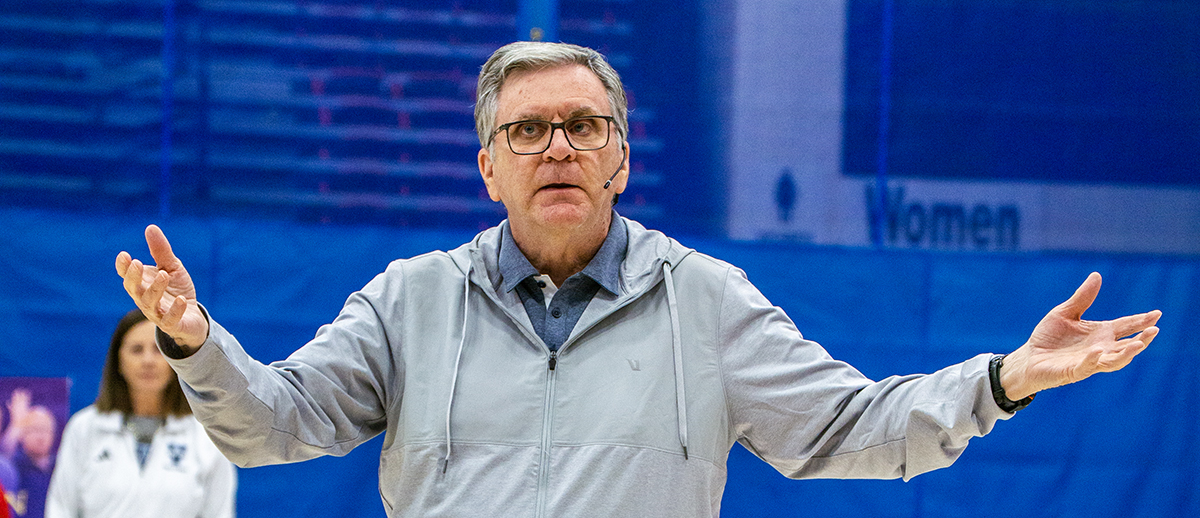

Jim Stone, who passed away on March 10, 2026 at age 73 after battling pancreatic cancer, was a dear friend of mine and a key contributor to the success of The Art of Coaching Volleyball.
One thing I always admired about Jim was his endless curiosity … about volleyball and life. His hunger for learning led him to be an avid book reader, a passion we shared. Over the years, we had many intriguing discussions about books of all different subjects, from sports (Bill Walsh’s “The Winning Edge”) to psychology (“Thinking Fast and Slow”) to personal development (“Atomic Habits”). That’s something I’m really going to miss.
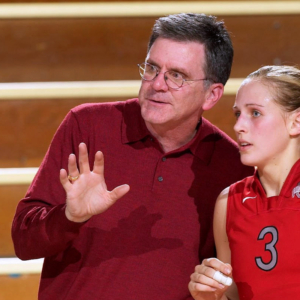 Of course, most people knew Jim as a volleyball coach, and he was as good as they come. After a notable playing career as a multi-skilled outside hitter at Ball State, Jim coached at the University of Wyoming and then, for 26 years, at Ohio State, where his women’s team posted an impressive 531-294 record. Under Jim’s guidance, the Buckeyes won three Big Ten titles and reached 15 NCAA tournaments, advancing to the NCAA semifinals in 1991 and 1994. He was selected to the Ohio State Athletics Hall of Fame in 2012 and the American Volleyball Coaches Association Hall of Fame in 2021.
Russ Rose, a co-founder of The Art of Coaching Volleyball who led the Penn State women’s team to a record seven NCAA titles, faced Jim many times in Big Ten matches over two decades. He says it was always a battle.
“To beat Ohio State, you had to earn it,” Russ says. “They weren’t going to give it to you. Jim was an exceptional leader, and he held his teams to a high standard. They always trained and competed hard, and they were always loyal to the university and to him as a coach.”
Russ recalls that Jim’s teams were tough from the very first point of the match.
“A lot of teams fooled around a little bit until they got their feet wet, and then they’d get in the flow of the game,” Russ says. “With Jim’s teams, you needed to be ready at the first whistle, because if you weren’t, you were going to be down an insurmountable amount. They always had the ability to come out of the gates strong and compete at a high level.”
Another longtime colleague and good friend of Jim’s was John Dunning, who won five NCAA titles as a coach and is also an AOCVB co-founder. John remembers Jim as “a wonderful person” who had a sharp and creative volleyball mind.
“I do a lot of thinking about volleyball, and I know a lot of people who do the same,” John says. “If I was going to pick five people to sit in a room with to creatively talk about coaching, Jim would definitely have been one of them.”
John says that one unmistakable trademark of Jim’s teams was competitiveness.
“His teams played just crazed defense,” John says. “It seemed like you would look through the net at them, and, just like with Russ’s teams, you knew you were going to be in a fight. When Jim coached, he had a clear image of what he wanted his team’s identity to be. He wanted them to battle people.”
Beyond the battles in college volleyball, Jim had numerous other successes. A big one came in 2019 when he was head coach of the USA Girls Youth National Team (U18/U19) that won the FIVB World Championship. It was the first-ever gold medal for a USA age-group team.
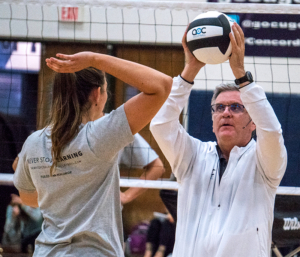 It could be that Jim’s biggest contribution to our sport was as a trusted source of valuable information. Nobody in the past three or four decades has put out more good volleyball tutorials or offered better advice than Jim. He provided great insights through his videos, his newsletters, and his podcasts, and, in retirement, he was sought out by many college coaches as a consultant. Jim inspired you to think about the way you coached or played, and he made you reflect on how you could be better.
“Jim had a really good handle on presenting his thoughts, and he had the technical skills to incorporate video into his content,” Russ says. “His absence will leave a big void in the coaching education area.”
John says: “I loved the different ways he looked at things. I loved his use of video and the way he showed and explained things in a very simple way. It was always very clear. Not everybody can do that. When you listened to him or watched him talk about volleyball, he came across as an open, caring person who just wanted to help. He wanted to help kids. He wanted to help coaches. He wanted to help the sport.”
I’ll miss Jim more than words can express, but I take comfort in knowing that his teachings will live on for generations to come. In his final newsletter, he offered this:
“I encourage you to keep your intellectual curiosity alive about how to best teach this great game to our youngsters. Finally, in our profession, there will always be emotional peaks and valleys. Stay focused on how fortunate you are to have the opportunity to impact the lives of our young athletes.”
Words to remember from a coach worth remembering.

Terry Liskevych, who founded The Art of Coaching Volleyball with Russ Rose and John Dunning, coached the U.S. women’s national team at three Olympics, including 1992, when they won a bronze medal in Barcelona. Collegiately, he coached the men’s program at Ohio State and the women’s programs at University of the Pacific and Oregon State.